
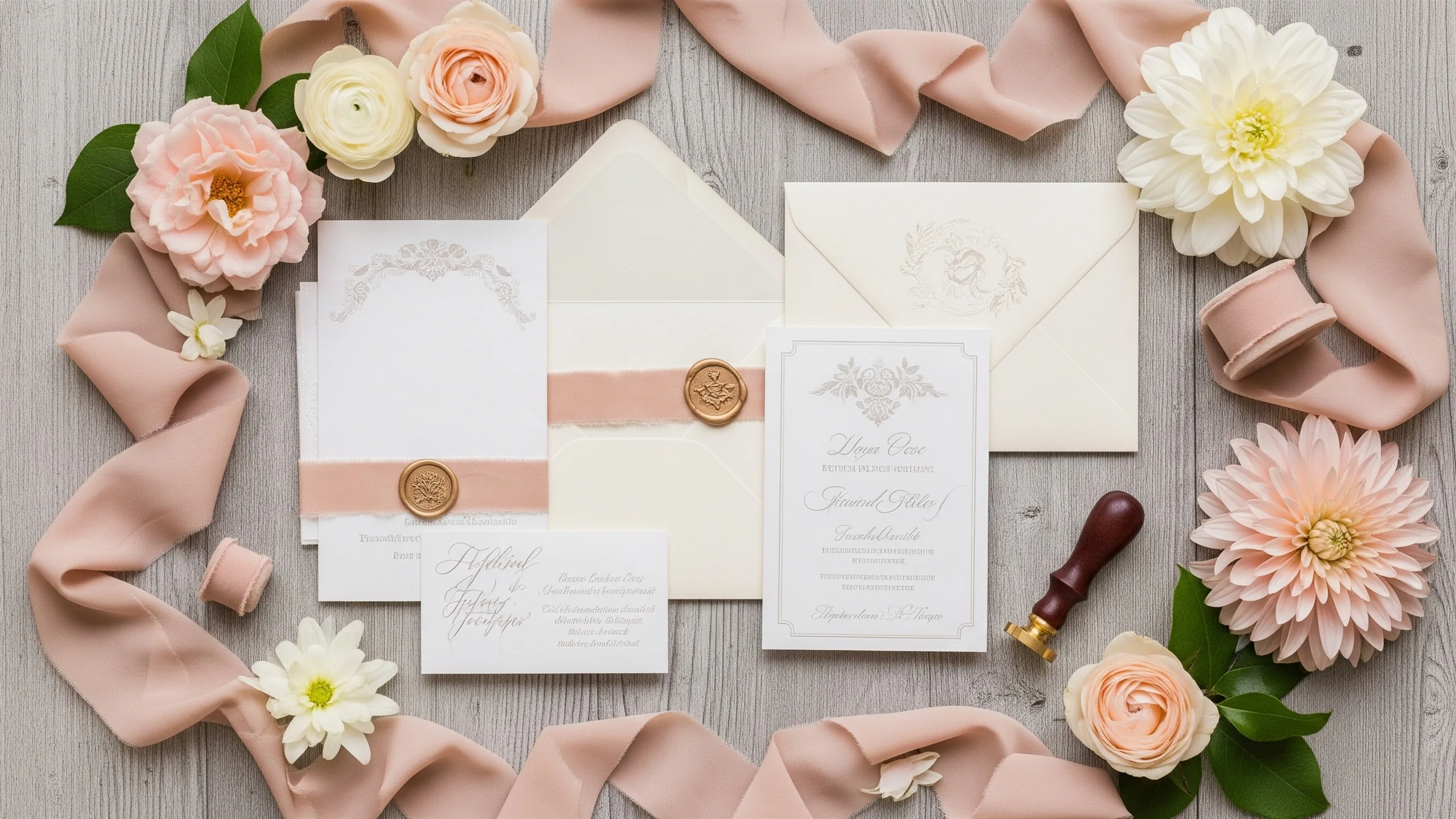
A wedding invitation follows a clear order: a host line (who invites), the request line, the couple's names, the date and time, the venue, and how to RSVP. Decide who is hosting and name them with care — it is the most sensitive part. Keep the card itself elegant and uncluttered, and move schedules, maps and dress codes to an insert or a wedding website link. Match the tone of the wording to the formality of your wedding.
The decisions that matter most
- 01
Follow the standard order — host line, request, names, date/time, venue, RSVP.
- 02
The hosting line is the most sensitive — handle divorced, late or joint-hosting parents thoughtfully.
- 03
Match wording tone to wedding formality — traditional, contemporary or playful, but consistent.
- 04
Keep the card uncluttered — move the schedule, maps and dress code to an insert or website.
- 05
Always give a clear RSVP method and date — vague invitations get vague replies.
Use the planning tool, adapt the framework to your family, and verify current prices or policies before committing.
Hosting lines for every family
The trickiest line on any card. Pick the framing that fits your family and adapt the names.
Traditional framing
“Mr & Mrs Sharma request the pleasure of your company at the wedding of their daughter…”
Joint hosting
“Together with their families, [Bride] and [Groom] invite you to celebrate their wedding…”
Modern, couple-led
“[Bride] and [Groom], together with their families, request the honour of your presence…”
With grace
“…daughter of [Name] and the late [Name]…” — name a late parent warmly, without making the card heavy.
The standard order of an invitation
Almost every wedding invitation, traditional or modern, follows the same skeleton. Get the order right and the wording feels effortless.
- Host line — who is inviting the guests.
- Request line — "request the pleasure of your company" or a warmer modern equivalent.
- The couple — the names, in the order your family prefers.
- Date and time — written clearly, with the day of the week.
- Venue — name and city (full address can go on an insert).
- RSVP — how and by when to reply.
*Tip — Read the whole card aloud. If it does not flow when spoken, rework it. An invitation is a spoken welcome on paper.

The hosting line — handle it with care
This is the line families agonise over, because it signals who is hosting and whose names appear. There is no single right answer — only the one that fits your family.
- Traditionally, the bride's parents host and are named first.
- Increasingly, both families host jointly, or the couple hosts and names both families.
- For divorced parents, you can list them on separate lines, or use a neutral "together with their families" framing that sidesteps the question gracefully.
- For a late parent, name them warmly — "daughter of [Name] and the late [Name]" — without turning the card sombre.
!Discuss the hosting line with both families before printing. It is the most common cause of last-minute invitation reprints — and hurt feelings.
Match the tone to your wedding
The wording should sound like your wedding, and stay consistent across the card.
| Tone | Request line feel | Best for |
|---|---|---|
| Traditional / formal | "request the pleasure of your company" | Grand, ceremonial weddings |
| Contemporary | "would love for you to join us" | Most modern Indian weddings |
| Warm / personal | "we're getting married — come celebrate" | Intimate, relaxed celebrations |
| Playful | A line of humour or a couplet | Sangeet-forward, fun weddings |
Religious and cultural openings
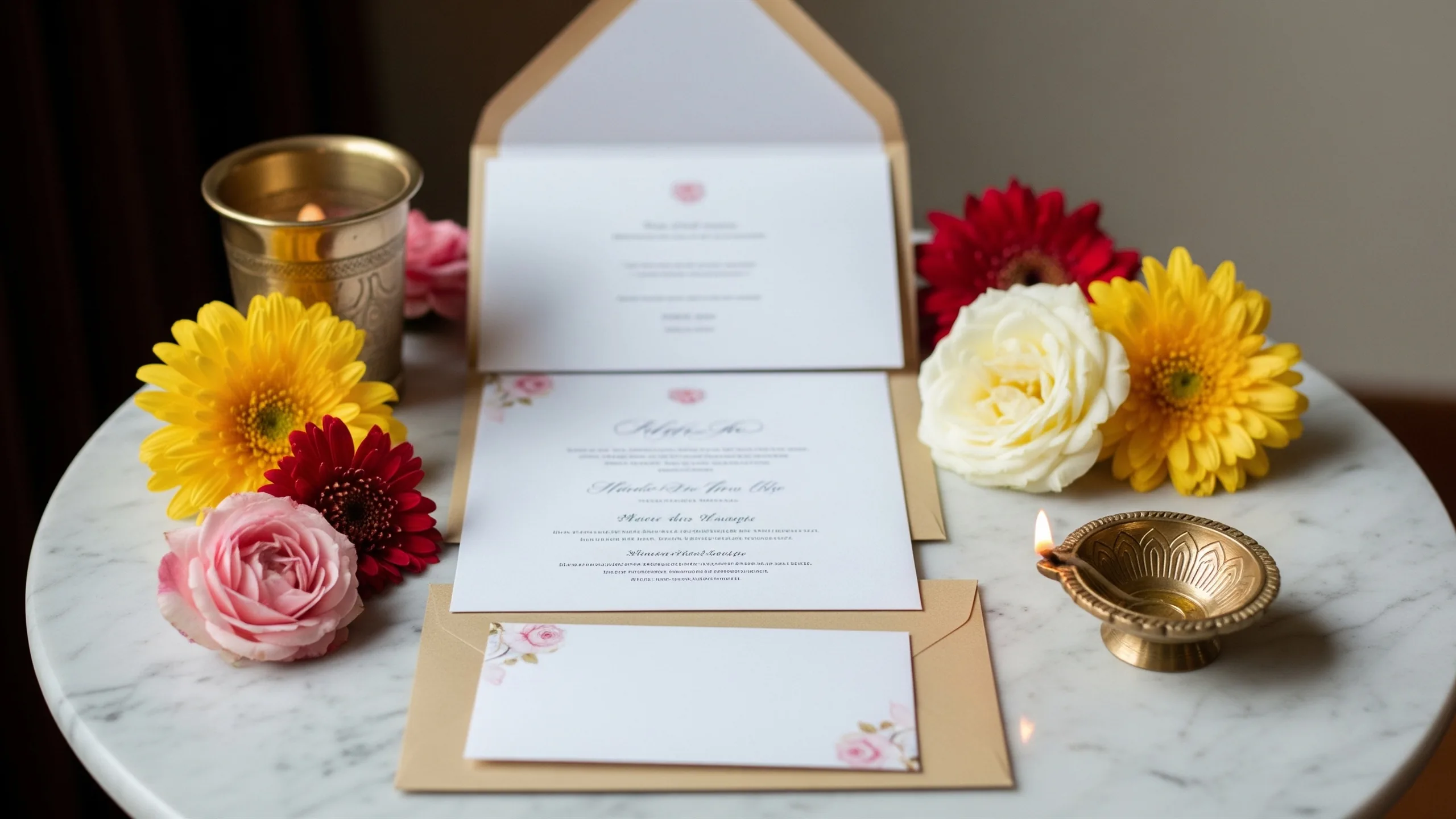
Many Indian invitations open with an invocation, and the convention varies by community.
- Hindu cards often open with "॥ Shubh Vivah ॥", a Ganesha invocation, or "Om".
- Sikh cards open with "Ik Onkar" and reference Anand Karaj.
- Muslim cards open with "Bismillah" and reference the Nikah.
- Christian cards reference the church ceremony and may include a short scripture line.
Keep the opening authentic to your family's tradition, and ensure spellings and symbols are correct — these errors are the hardest to forgive.
RSVP etiquette
A vague RSVP line produces vague replies and a catering headache.
- Give a clear method — a phone number, a name, or a wedding-website RSVP link.
- Set a date — "kindly reply by [date]" — and make it two to three weeks before the wedding.
- Specify per-event if guests are invited to some functions and not others.
- Avoid "regrets only" for Indian weddings, where headcounts genuinely matter for catering.
What to leave OFF the card
The most elegant invitations are uncluttered. Resist the urge to cram everything onto the main card.
- Detailed schedules of multiple functions → an insert or website.
- Maps and directions → a website with one-tap maps.
- Dress codes per event → an insert or website event cards.
- Travel and hotel details for out-of-town guests → a website.
- Gift or registry notes → handled gently, never on the main card front.
The card sets the tone; the link carries the logistics. Keeping them separate is what makes a wedding feel organised and the invitation feel beautiful.
Ready-to-adapt examples
Traditional "Mr & Mrs [Surname] request the pleasure of your company at the wedding of their daughter [Bride] to [Groom], son of Mr & Mrs [Surname], on [day], [date] at [venue]."
Contemporary, joint hosting "Together with their families, [Bride] & [Groom] would love for you to join them as they begin their forever, on [date] at [venue]."
Warm and modern "We're getting married! [Bride] & [Groom] invite you to eat, dance and celebrate with us on [date] at [venue]. RSVP by [date]."
FAQ
What is the correct order for wedding invitation wording?
The standard order is: the host line (who is inviting), the request line, the couple's names, the date and time, the venue, and the RSVP details. Almost every formal and modern invitation follows this skeleton, with the wording tone adjusted to the wedding's style.
Whose name goes first on a wedding invitation?
Traditionally the bride's parents host and are named first, followed by the bride and then the groom. Many modern couples use a "together with their families" framing or name both families equally. Choose what fits your family and discuss it before printing.
How do you word an invitation when parents are divorced or deceased?
For divorced parents, list them on separate lines or use a neutral "together with their families" framing. For a late parent, name them warmly — for example "daughter of [Name] and the late [Name]" — without making the card sombre.
What should NOT go on the main invitation card?
Keep detailed function schedules, maps, per-event dress codes, travel and hotel information, and gift notes off the main card. Move them to an insert or, better, a wedding website link — so the card stays elegant and the logistics stay clear.
One link instead of five inserts
The moment a wedding has more than one function, the invitation envelope starts to bulge — a schedule insert, a directions card, a dress-code note, a hotel slip. Each one is another thing to design, print and risk getting wrong.
A wedding website replaces all of them with a single line on the card: one link where guests find the full schedule, maps, dress codes, travel help and RSVP. The card stays beautiful and minimal, and you can fix a detail after printing without reprinting anything.
- Print one elegant card; put every logistic on the link.
- Update a time or venue after printing — no reprints.
- Collect per-event RSVPs for accurate catering numbers.

Scope, assumptions and editorial standard
Wording conventions and etiquette here are editorial guidance based on common Indian invitation practice; the right framing depends on your family, community and tradition. Confirm names, spellings, religious invocations and hosting lines with both families before printing.
Make every detail feel considered.
Keep your card beautiful and put the logistics on your wedding website link.
& Vihaan 12 · 13 · 14 December