
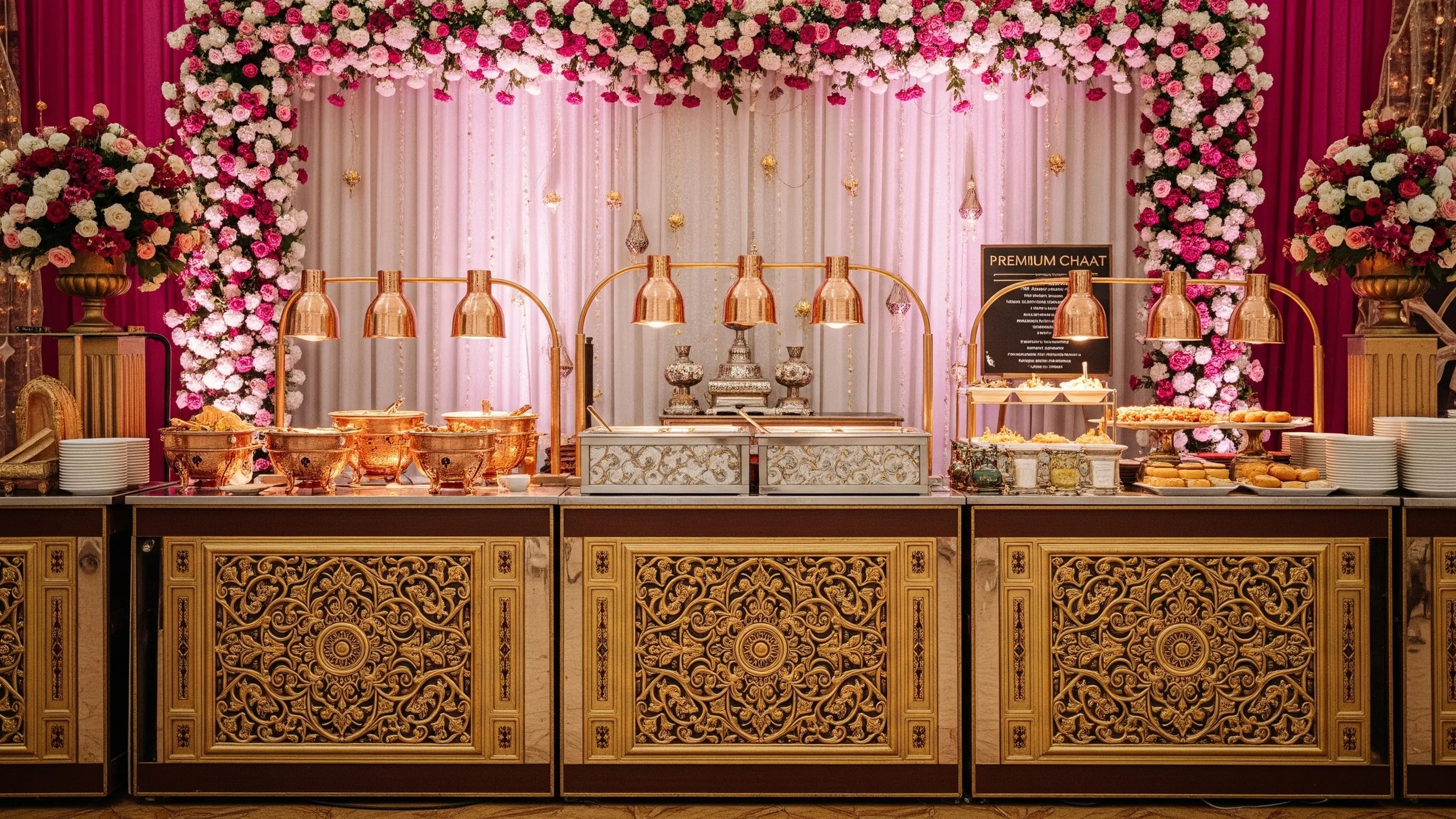
Catering is usually 40–55% of an Indian wedding budget. Per-plate cost runs roughly ₹800–₹1,500 for a simple buffet, ₹1,500–₹2,500 for premium, and ₹2,500+ for luxury/plated. Lock the menu around your guests and season, confirm exact quantities and live-counter counts in writing, and always do a tasting before signing.
The decisions that matter most
- 01
Catering is the single biggest line item — get it right before decor or anything cosmetic.
- 02
Confirm per-plate price AND minimum guest count in writing; that is where bills balloon.
- 03
Build the menu around your guests and the season, not the caterer's signature list.
- 04
Do a tasting for the actual dishes and quantities — never approve from a brochure.
- 05
Plan live counters and dessert as the experience; that is what guests photograph.
Use the planning tool, adapt the framework to your family, and verify current prices or policies before committing.
Catering cost estimator by city
Approximate catering spend for a 300-guest premium reception (food + service), by city. Tap a city.
Huge competition keeps mid-range value strong; farmhouse venues add service cost.
Understand what catering really costs
For most Indian weddings, food and service is 40–55% of the entire budget. It is also the part guests judge instantly and remember for years. Get the number right here and the rest of your budget behaves.
| Style | Per-plate (metro) | Best for |
|---|---|---|
| Simple buffet | ₹800–₹1,500 | Day functions, large guest lists |
| Premium buffet | ₹1,500–₹2,500 | Reception, sangeet |
| Luxury / plated / multi-cuisine | ₹2,500+ | Intimate or high-end weddings |
The headline per-plate price is only half the story. Service charge, live-counter fees, minimum guarantees, and taxes decide your final bill.

Style the celebration with our wedding vendor booking timeline, wedding reception planning guide, and wedding tablescape and centerpiece ideas.
The two numbers that decide your bill
- Per-plate price — what you pay per guest.
- Minimum guaranteed plates — the count you pay for even if fewer attend.
A "₹1,200 per plate" quote with a 350-plate minimum costs the same whether 300 or 350 guests show up. This is exactly why a clean RSVP count matters — every uncertain guest is real money.
!Get the minimum guarantee, overtime charges, and "extra plate" rate in writing. Verbal assurances disappear on the invoice.
Structure the menu across events
Do not repeat the same spread three times. Give each function a distinct food identity:
- Haldi / morning: light, regional, comforting — chaat, South Indian, poha, fresh juices.
- Mehndi: finger food and a tea/coffee bar; nothing that stains busy hands.
- Sangeet: global street food, live counters, energetic — pasta, tandoor, momos, bar.
- Wedding: traditional, regional pride dishes; a strong sweet course.
- Reception: your most premium, polished spread; a signature live station.

Quantity and portion planning
Caterers plan portions, but you should sanity-check. As a rough guide for a buffet:
- 6–8 starters, 8–10 mains, 4–5 desserts is plenty for a premium reception.
- More dishes does not mean happier guests — it means waste and slower lines.
- Add one extra live counter per ~50 guests to prevent long queues.
- Keep a clearly labelled vegetarian and Jain section; mark allergens.
*Tip — Fewer, better dishes beat an overwhelming spread. Guests remember the perfect dal and the live jalebi, not 14 forgettable curries.
The tasting: do it properly
A tasting is non-negotiable, and it is your leverage point.
- Taste the exact dishes you plan to serve, at serving quantity, not shrunken samples.
- Bring 2–3 honest people with different palates (and your parents).
- Check temperature, spice level, and presentation, not just flavour.
- Confirm garnish, plating, and counter setup for live stations.
- Lock the final menu in writing immediately after.
Contract red flags to catch
- No written minimum guarantee or per-extra-plate rate.
- "Service charge" and taxes hidden until the final invoice.
- Vague staffing ratios — ask how many servers per guest.
- Live counters billed per hour with no cap.
- No clause for last-minute count changes.
FAQ
How much does wedding catering cost per plate in India?
Roughly ₹800–₹1,500 for a simple buffet, ₹1,500–₹2,500 for a premium buffet in a metro, and ₹2,500+ for luxury or plated service. Final cost depends on city, menu, live counters, and service charges.
What percentage of the wedding budget is food?
Typically 40–55%. It is almost always the largest single category, so finalise catering before discretionary spends like elaborate decor.
How many dishes should a wedding menu have?
For a premium reception, around 6–8 starters, 8–10 mains, and 4–5 desserts is generous. Quality and smooth service matter more than the number of dishes.
How many live counters do I need?
Plan roughly one counter per 50 guests to avoid queues — about 6–10 counters for a 300-guest reception. Place them apart to spread the crowd.
Do I really need a tasting?
Yes. Always taste the exact dishes at serving quantity before signing, and lock the final menu in writing afterwards. It is your best protection against a disappointing spread.
Why your RSVP count is a catering decision
Catering is priced per head against a minimum guarantee, so a fuzzy guest count is a direct financial risk. Every 'maybe' you cannot resolve is a plate you may pay for or a guest who arrives to no seat.
A per-event RSVP — collected through your wedding website instead of scattered WhatsApp replies — turns guesswork into a number you can hand the caterer. It also lets you flag dietary needs in advance, so the vegetarian and Jain sections are sized correctly.
- Collect per-event RSVPs so the catering count matches reality.
- Capture dietary preferences (veg, Jain, allergies) at RSVP time.
- Share final numbers with the caterer before the minimum-guarantee deadline.

Scope, assumptions and editorial standard
Per-plate ranges are editorial planning estimates for 2025–26 metro pricing and vary with venue, season, menu, and service model. The city estimator illustrates a 300-guest premium reception only. Confirm current per-plate pricing, minimum guarantees, and all service and tax charges in a written contract.
Make every detail feel considered.
Publish your menu highlights and meal timings on one guest-ready link.
& Vihaan 12 · 13 · 14 December