

Marriage registration is legally important for visas, joint accounts, insurance, and proof of marriage. Register under the Hindu Marriage Act (for already-solemnised Hindu/Sikh/Jain/Buddhist marriages) or the Special Marriage Act (inter-faith or civil marriages, which require a 30-day notice). Gather age proof, address proof, photos, and 2–3 witnesses, apply at your local registrar/SDM, and collect the certificate after verification.
The decisions that matter most
- 01
Registration is legally essential for visas, banks, insurance, and proof.
- 02
HMA registers an already-performed Hindu-family marriage; SMA is civil/inter-faith with a 30-day notice.
- 03
Core documents: age proof, address proof, photos, and witnesses' ID.
- 04
Bring 2–3 witnesses who attended or know of the marriage.
- 05
Processes vary by state and portal — confirm your local SDM/registrar's exact list.
Use the planning tool, adapt the framework to your family, and verify current prices or policies before committing.
Marriage registration document checklist
Tap each item as you gather it. Exact lists vary by state — confirm with your registrar.
Why you must register your marriage
A religious or social wedding ceremony is not, by itself, a legal record. A registered marriage certificate is the document the world recognises.
- Required for a spouse visa, passport, or immigration.
- Needed for joint bank accounts, insurance nominees, and property.
- Legal proof of marriage in any dispute.
- Mandatory in several states regardless of religion.
Even if your community ceremony felt complete, treat registration as a non-optional next step — ideally within a few weeks of the wedding.

Handle the legal side with our court marriage process in India, griha pravesh and post-wedding rituals, and who pays for an Indian wedding.
Which law applies to you
| Act | Who it's for | Key feature |
|---|---|---|
| Hindu Marriage Act (HMA), 1955 | Hindus, Sikhs, Jains, Buddhists already married | Registers a solemnised marriage; faster |
| Special Marriage Act (SMA), 1954 | Inter-faith, inter-caste, or civil marriages | 30-day public notice; marriage can be solemnised under it |
The HMA registers a marriage that has already happened by ceremony. The SMA is a civil route — used for inter-faith couples or those marrying without a religious ceremony — and includes a mandatory 30-day notice period.
Documents you'll typically need
- Age proof for both: birth certificate, passport, or 10th marksheet.
- Address proof for both: Aadhaar, passport, voter ID, or utility bill.
- Passport-size photographs (usually 4–6 each).
- Proof of marriage for HMA: wedding invitation and/or photos.
- Affidavits of marital status, date of birth, and nationality.
- Witnesses' ID and photographs (2–3 witnesses).
- For SMA: the notice and supporting identity/address documents.
!Document requirements differ by state and even by district. Always confirm the exact list on your state's official portal or with the local SDM/registrar before you apply.
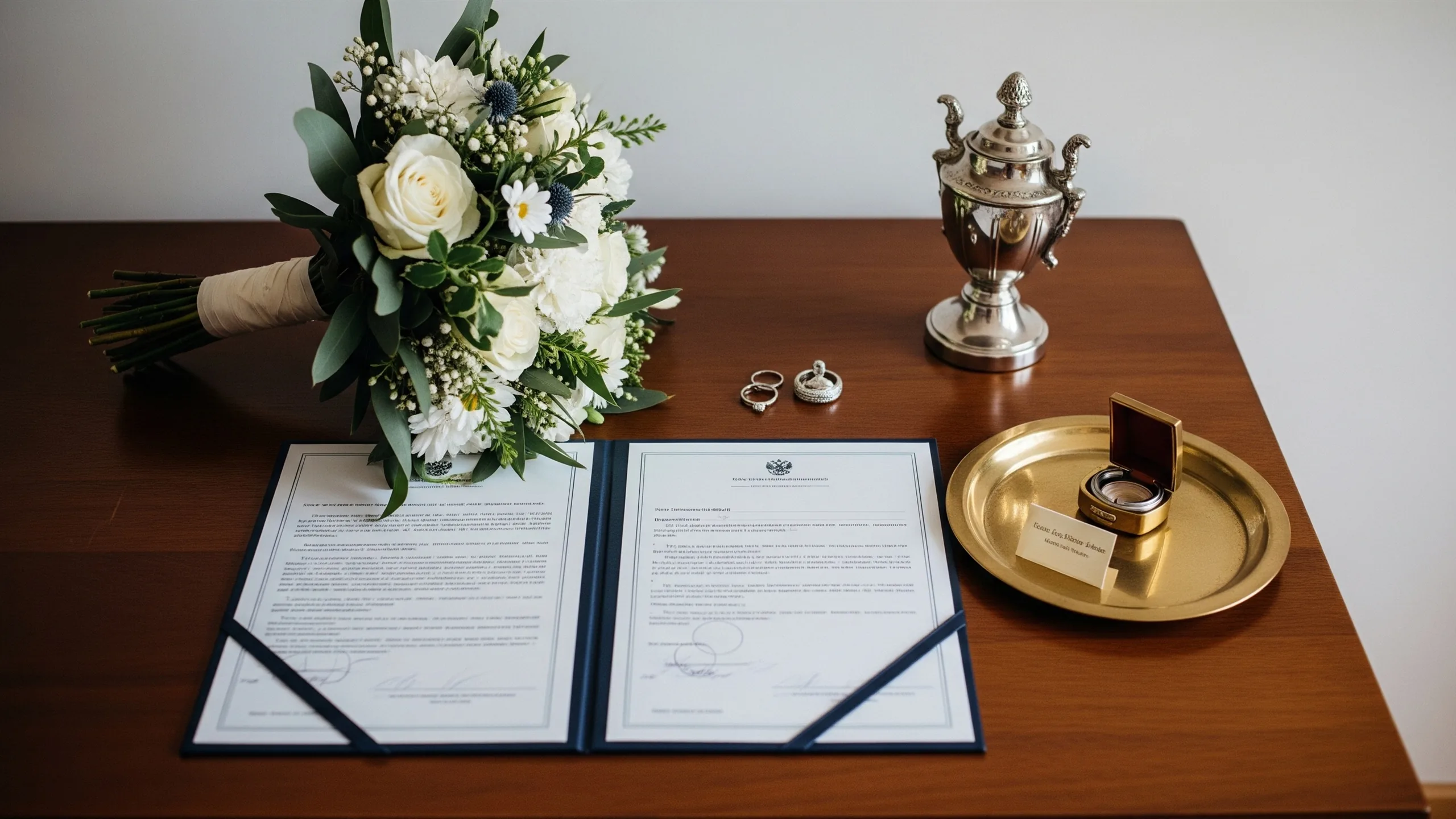
Step-by-step process
- Choose the Act (HMA or SMA) and your jurisdiction (where either spouse resides or married).
- Fill the application — online on many state portals, or in person — and gather documents.
- For SMA, file the 30-day notice; the registrar publishes it and the waiting period runs.
- Book an appointment and visit the registrar/SDM office with both spouses and witnesses.
- Verification of documents and witnesses takes place.
- Collect the marriage certificate once approved (timing varies by state).
Witnesses, fees, and timeline
- Witnesses: usually 2–3 people who attended or can vouch for the marriage, each with ID and photos.
- Fees: modest and vary by state (often a few hundred rupees); some portals add service charges.
- Timeline: HMA can be quick (sometimes same-week after appointment); SMA takes at least 30+ days due to the notice.
After you receive the certificate
- Keep multiple certified copies and a digital scan.
- Use it to update passport, bank, insurance, and visa records.
- Store the original safely — replacing it is slow.
FAQ
Is marriage registration mandatory in India?
It is legally essential and mandatory in several states. Even where a ceremony has taken place, you need a registered certificate for visas, banking, insurance, and legal proof of marriage.
What is the difference between the Hindu Marriage Act and the Special Marriage Act?
The HMA registers an already-solemnised marriage between Hindus, Sikhs, Jains, or Buddhists and is faster. The SMA is a civil law for inter-faith, inter-caste, or civil marriages and requires a mandatory 30-day public notice.
What documents are needed to register a marriage?
Typically age proof and address proof for both spouses, passport-size photos, proof of marriage (for HMA), affidavits, and 2–3 witnesses with ID and photos. Exact lists vary by state.
How many witnesses are required?
Usually two to three witnesses who attended or can vouch for the marriage, each carrying valid ID and passport photographs.
How long does marriage registration take?
Under the HMA it can be quick — sometimes within the same week of your appointment. Under the SMA it takes at least 30 days because of the mandatory notice period, plus verification time.
Keep the wedding organised while you handle the paperwork
Registration is one of many threads couples juggle alongside events, guests, and travel. A single source of truth for the wedding itself keeps the family aligned while you focus on the legal steps.
A wedding website holds your schedule, venues, maps, and RSVP in one link, so the celebration runs smoothly even as you tackle errands like registration, name changes, and bank updates in the background.
- Use one link to keep event details and updates organised for the family.
- Tackle registration within a few weeks of the wedding while documents are fresh.
- Order extra certified copies for visa and bank updates.

Scope, assumptions and editorial standard
This guide is general editorial information about marriage registration in India, not legal advice. Marriage law is administered at the state level, and documents, fees, portals, and timelines differ by state and district and change over time. Always confirm current requirements with your state's official registrar/SDM or government portal, and consult a lawyer for complex or inter-jurisdictional cases.
Make every detail feel considered.
Keep your wedding details and updates organised on one link the whole family can use.
& Vihaan 12 · 13 · 14 December